
Honda CR-V: Fastening a Seat Belt / Advice for Pregnant Women
If you are pregnant, the best way to protect yourself and your unborn child when driving or riding in a vehicle is to always wear a seat belt and keep the lap part of the belt as low as possible across the hips.

Each time you have a checkup, ask your doctor if it is okay for you to drive.
To reduce the risk of injuries to both you and your unborn child that can be caused by an inflating front airbag:
- When driving, sit upright and adjust the seat as far back as possible while allowing full control of the vehicle.
- When sitting in the front passenger's seat, adjust the seat as far back as possible.
 Seat Belt with Detachable Anchor
Pull out the seat belt’s small latch plate and
the latch plate from each holding slot in the
ceiling.
Line up the triangle marks on the small
latch plate and anchor buckle...
 Seat Belt Inspection
Regularly check the condition of your seat belts as follows:
Pull each belt out fully, and look for frays, cuts, burns, and wear.
Check that the latch plates and buckles work smoothly and the belts
retract
easily...
Other information:
Honda CR-V 2017-2026 Owner's Manual: Maintenance Items Under the Hood
Opening the Hood Park the vehicle on a level surface, and set the parking brake. Pull the hood release handle under the lower left corner of the dashboard. The hood will pop up slightly. Push the hood latch lever (located under the front edge of the hood to the center) to the side and raise the hood...
Honda CR-V 2017-2026 Owner's Manual: Changing the Rear Wiper Blade Rubber
Raise the wiper arm off. Pivot the bottom end of the holder up until it comes off from the wiper arm. Slide the blade out of the holder. Remove the retainers from wiper blade and mount to a new rubber blade. Slide the new wiper blade onto the holder...
Categories
- Manuals Home
- Honda CR-V Owners Manual
- Honda CR-V Service Manual
- Display Setup
- Auto Idle Stop System ON/OFF
- USB Port(s)
- New on site
- Most important about car
Seat Belt Reminder
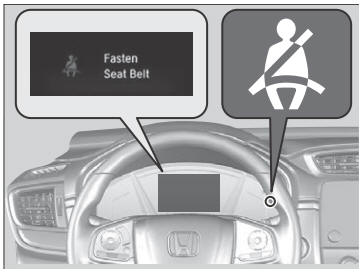
The seat belt system includes an indicator on the instrument panel to remind the driver or a front passenger or both to fasten their seat belts.
If the ignition switch is turned to ON
 *1 and
a seat belt is not fastened, a beeper will sound
and the indicator will blink. After a few
seconds, the beeper will stop and the
indicator will come on and remain illuminated
until the seat belt is fastened.
*1 and
a seat belt is not fastened, a beeper will sound
and the indicator will blink. After a few
seconds, the beeper will stop and the
indicator will come on and remain illuminated
until the seat belt is fastened.
